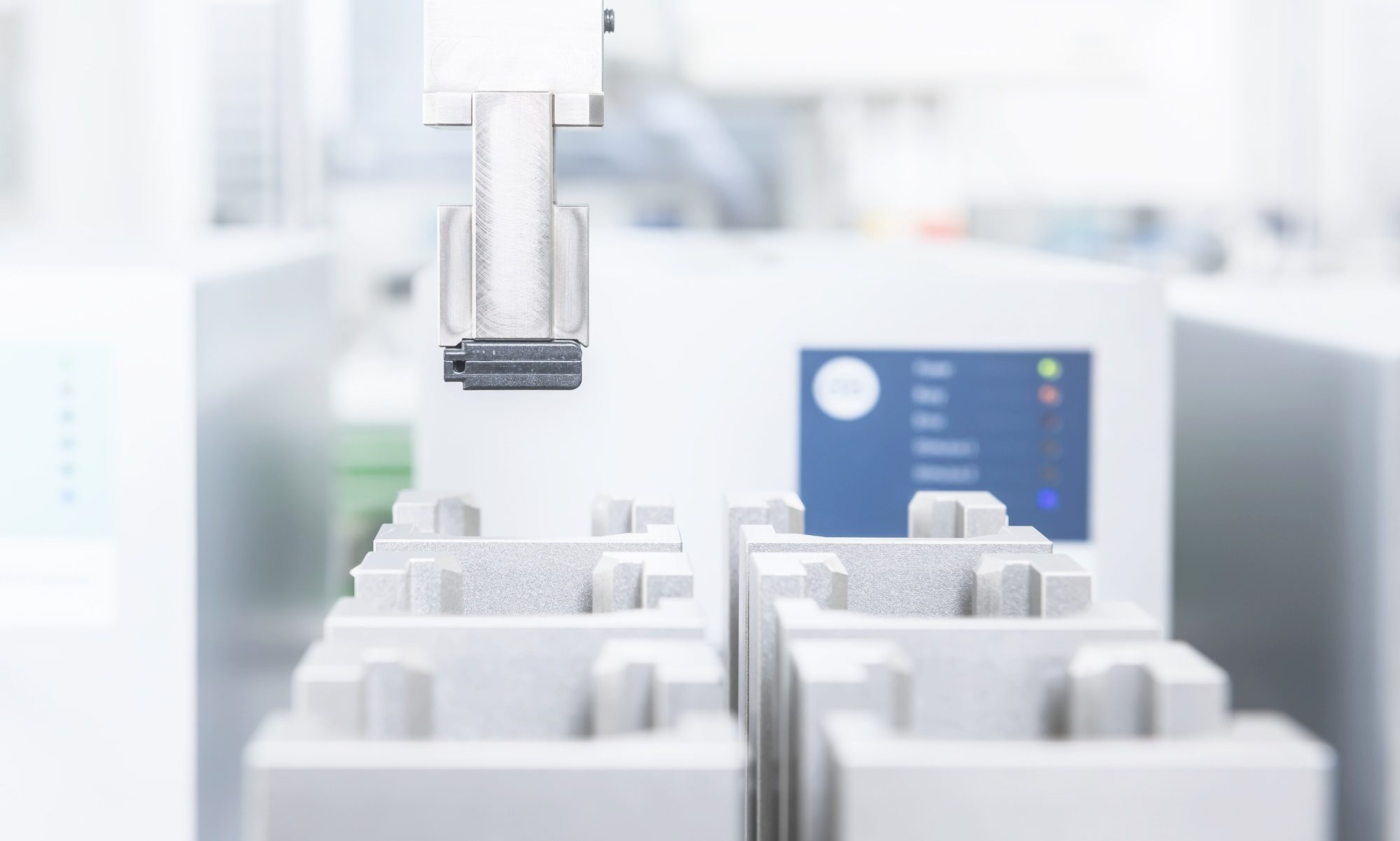


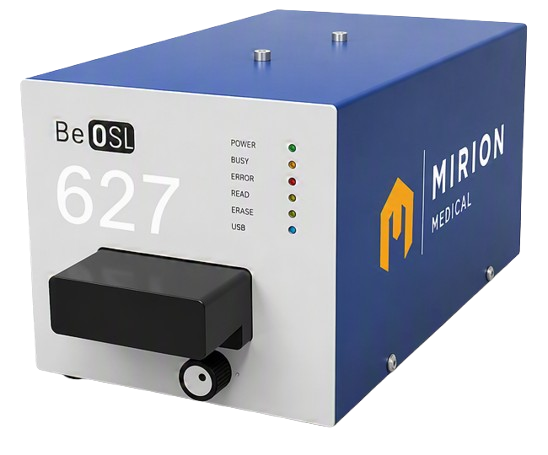
BeOSL Reader 2.1
The compact new design combines Reader and Eraser in size of the first generation BeOSL Reader. The integrated erasing function saves handling time and speeds up the process. Using our software packages Workflow and LabClient, the BeOSL Reader 2.1 can be operated alongside the first-generation BeOSL Reader (P/N 2001) and the BeOSL Eraser (P/N 2002).
The BeOSL Reader 2.1 measures radiation exposure using a state-of-the-art technology, called optically stimulated luminescence (OSL). The detector material of our BeOSL Dosimeters is beryllium oxide (BeO). During the read out process, the material is exposed to light from a LED light source. This stimulus causes an instantaneous light emission from the BeO detectors which is measured by photomultiplier tubes (PMT). For a given stimulus, the amount of released light is directly proportional to the radiation dose to which the dosimeter was exposed.
Features
The BeOSL Reader can be operated either manually or combined with one of our solutions for automation. It is designed to read two- and four-element BeOSL Dosimeters, and our single element called BeOSL ezClip. It allows multiple dosimeter readouts (re-reads) for dose result verification, dosimeter archiving or dose tracking. Unlike other systems, the BeOSL Reader 2.1 automatically extracts the card with the detector elements from the dosimeter assembly and pushes it back in after the readout. In manual operation the extremely short readout time allows an operator to process at least 90 dosimeters per hour.
Highest Quality and Compliances
The BeOSL Reader 2.1 is compliant to IEC 62387. The 2-element version of our BeOSL Dosimeters measures Hp(10) and Hp(0,07) simultaneously within the limits of IEC 62387. The dose algorithms are linear and not based on a distinction of cases.
The BeOSL Reader 2.1 is CE compliant. It is part of a dosimetry system that is PTB type tested (Physikalisch-Technische Bundesanstalt, Braunschweig, Germany) under reference number DE-26-M-PTB-0013.
The well-engineered design, top class components and local manufacturing in Germany ensure millions of readouts without noticeable downtime.